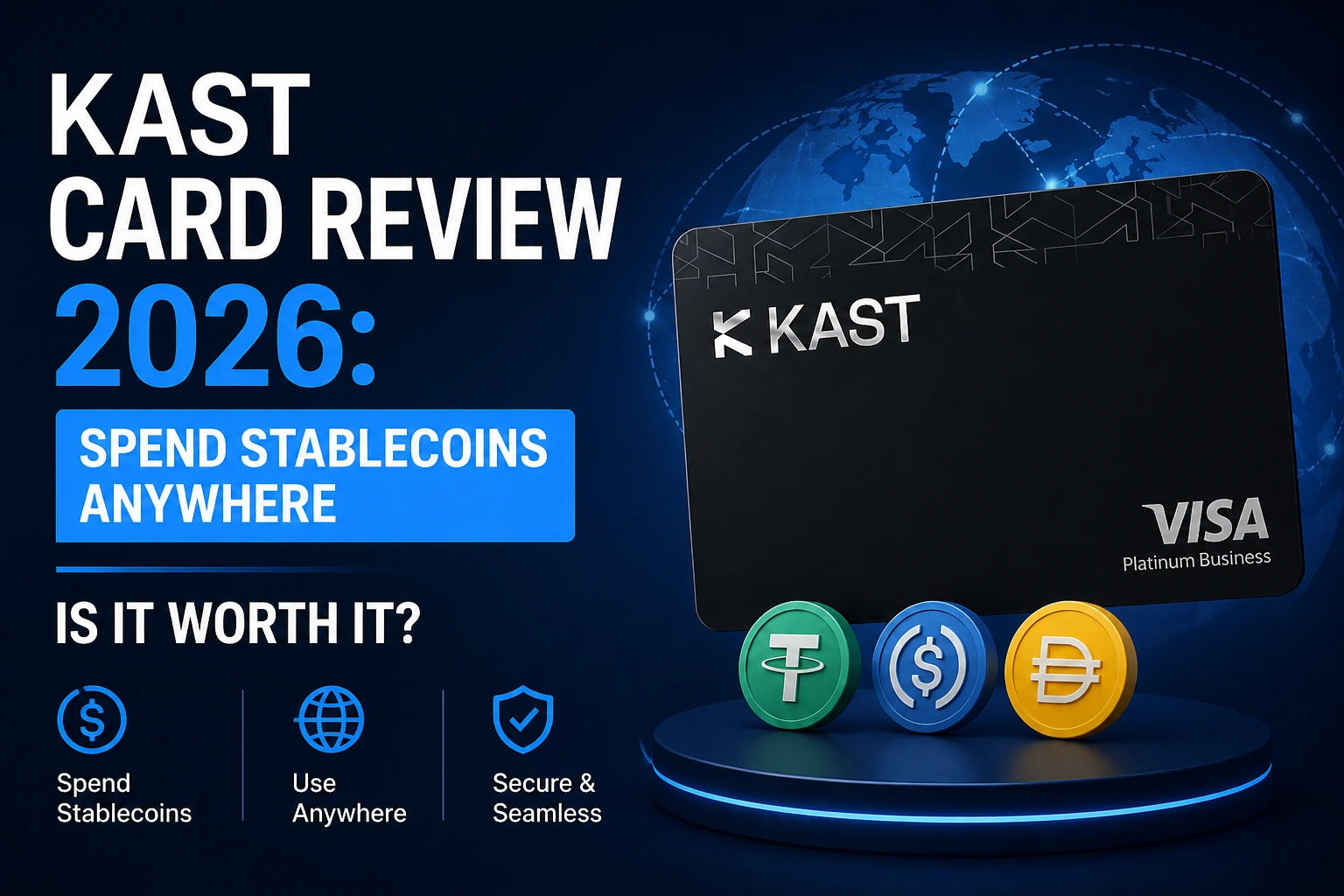
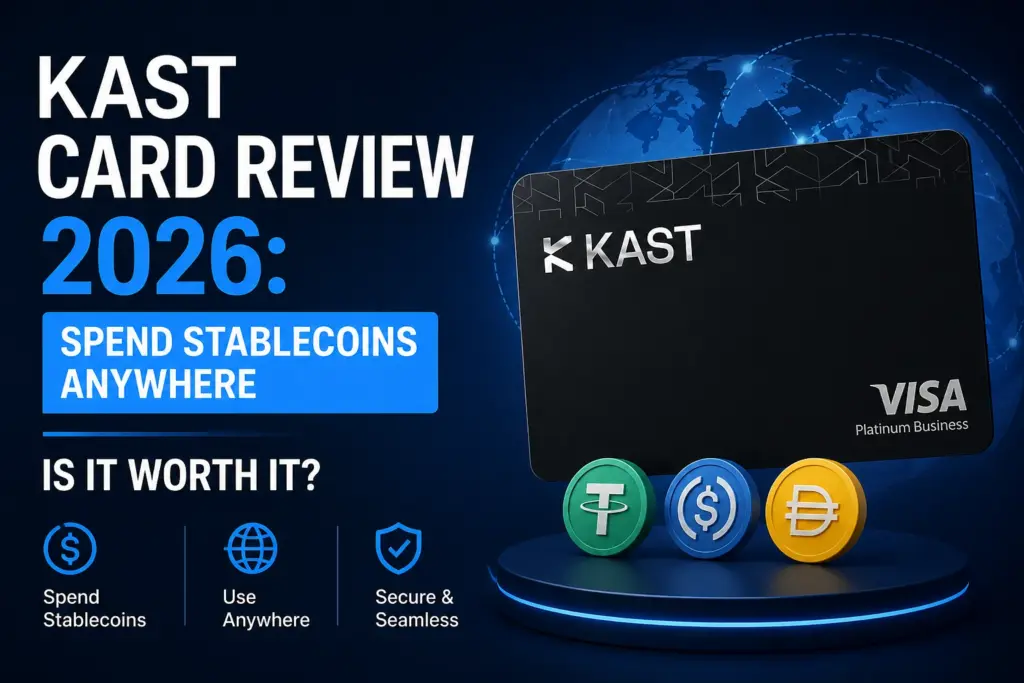
KAST Card Review 2026: Spend Stablecoins Anywhere – Is It Worth It?
KAST is a Visa card that lets you spend USDC, USDT, and other stablecoins at 150M+ merchants globally. Here’s the real breakdown – rewards, fees, and who it actually makes sense for.
My bank flagged my account last year because I hadn’t used my debit card in two months. The reason? I’d switched almost entirely to KAST – a Visa card that runs on stablecoins – and forgot my old card existed.
That’s either a glowing endorsement or a cautionary tale, depending on how you look at it. Here’s the honest version.
What Is KAST and Who Is It For?
KAST is a financial platform built for people whose money lives on-chain. Freelancers getting paid in USDC. Remote workers holding stablecoin savings. Crypto users who are done converting to fiat just to buy groceries.
You deposit stablecoins – USDC, USDT, USDe, and now SOL, ETH, or BTC (which auto-convert to USDC) – into your KAST account. When you spend, the platform converts the exact amount at checkout and processes it as a standard Visa transaction. No manual off-ramping. No waiting 3 business days.
The company was founded in 2024 by a former Circle executive — the people behind USDC — and raised $10 million in seed funding. That’s not nothing. It means they know stablecoins from the inside, which shows in how cleanly the deposit flow works.
Who this is actually built for: global earners, crypto-native founders, digital nomads, and anyone tired of paying 3-4% off-ramp fees just to spend their own money. If you’re casually DCA-ing Bitcoin and want a rewards card, there are simpler options.
Card Tiers Broken Down (No Fluff)
KAST has more card tiers than most people expect. Here’s what the lineup actually looks like:
- K Card — $20/year. Virtual + physical. 2–6% cashback. Entry point.
- Solana Card — $20/year. Same as K Card but adds 3.5–7% APY boost on staked SOL.
- X Card — $1,000/year. 5–12% cashback. Metal card. Premium support.
- Solana Illuma — $1,000/year. LED-illuminated physical card. 7–14% APY boost on SOL. Conversation starter at checkout.
- Founders Edition — $5,000 one-time fee. 5–12% cashback. VIP concierge.
- Solana Gold — $10,000/year. Up to 18% cashback + 21% APY boost on SOL staking.
- Solana Solid Gold — Invite only. The vault is closed.
For most people, the K Card or Solana Card is the right starting point. The $1,000/year tiers only make mathematical sense if you’re spending heavily enough for the extra cashback percentage to offset the fee — or if you’re staking a serious SOL position and want that APY bump.
I started on the K Card. Still there. The 2–6% return on everyday spending is already better than most traditional credit cards, and I’m not paying $1,000 to find out.
The Rewards System — How Much Are KAST Points Actually Worth?
This is where it gets interesting — and where you need to read the fine print.
KAST Points are the reward currency across all tiers. Right now, 1 point = $0.10 USD. You earn them on every card transaction, referrals, and milestone bonuses like:
- 200 points ($20) after your first $100 spent
- 200 points ($20) after your 5th transaction
- 10,000 points ($1,000) when you buy your first premium card
There’s also an ongoing 4% cashback in $MOVE tokens on all spending — which you can already convert to cash. That’s on top of your base KAST Points rate.
The catch: KAST Points can’t be redeemed yet. They’ll convert to $KAST tokens when the token launches (currently slated for Q4 2026). That means you’re banking on a future token having actual value. That’s a bet, not a guarantee.
Worth it? For anyone already spending stablecoins daily — yes, probably. You’re getting paid to do something you’d do anyway. If you’re hoping to flip KAST points into a windfall, manage those expectations.
Real-World Performance: What Users Are Saying
The user experiences I’ve seen fall into two clear camps.
On the positive side: people love how fast the deposits land, how seamless Apple Pay integration is, and that the card genuinely works internationally without drama. One user mentioned using it across Toronto, Panama, and Argentina in six weeks without a single decline. Another set up Apple Pay and completed a Deliveroo order inside five minutes of loading SOL. That kind of frictionless cross-border spending is the whole pitch — and it delivers.
The negative camp is real too. Trustpilot shows a mixed picture: roughly 53% five-star, 43% one-star, with a score sitting around 3.3 out of 5. The main complaints cluster around:
→ Customer support being email-only and slow on complex issues
→ Accounts getting blocked for “security reasons” with funds stuck in limbo
→ Some regions getting quietly dropped without much notice
→ KYC rejections with no explanation given
I’ve had zero issues personally, but I also don’t keep large balances on the card. I’d treat KAST like a spending wallet, not a savings account. Load what you need, spend it, repeat.
Where KAST Falls Short
Honest takes:
ATM withdrawals are pricey. Compared to crypto cards like Bleap or Holyheld, KAST charges more per ATM withdrawal. Fine if you’re mostly spending digitally. Less fine if you travel somewhere cash-heavy.
Customer support isn’t there yet. Email-only support is forgivable at the early stage — but not when someone’s $270 in refunds are stuck. This is the biggest red flag for high-balance users.
The token is still vaporware. KAST Points are worth something on paper. Whether $KAST the token holds value at launch is unknown. Don’t treat the points as guaranteed income.
KYC requirements. Full identity verification is required. Privacy-conscious users: this isn’t the card for you.
Physical card delivery is slow. Virtual card is instant, which is great. But if you want the physical card — particularly the cooler metal tiers — expect weeks. Some users report months.
KAST vs. Other Crypto Cards
Quick honest comparison for context:
- vs. Coinbase Card — Coinbase has more brand trust and broader crypto support, but charges higher conversion fees and lower rewards (1–4%). KAST wins on rewards and zero stablecoin conversion fees.
- vs. Nexo Card — Nexo offers a credit mode (borrow against your crypto) and up to 2% cashback. KAST gives higher raw cashback but is debit-only.
- vs. Crypto.com Visa — Crypto.com has been around longer, has more perks tiers, and requires staking CRO to unlock the good rewards. KAST is simpler to get started and more stablecoin-native.
If your primary asset is stablecoins and you want the highest reward rate without locking up a platform token, KAST is hard to beat right now.
Should You Get One?
Get it if:
- You hold and earn in USDC, USDT, or stablecoins regularly
- You want a Visa card that works globally without FX fees
- You’re interested in the $KAST token upside and want points accumulating now
- You’re a digital nomad or remote worker who gets paid on-chain
Skip it if:
- You need robust customer support for large balances
- You want an established, well-known brand behind your card
- You care about financial privacy and want minimal KYC
- You primarily hold volatile crypto, not stablecoins
The K Card at $20/year is a no-brainer to try. Virtual card activates instantly — you can be spending in under five minutes. If it works for your lifestyle, you’ll know within a week.
And if your bank calls asking if you’re okay because you haven’t used your old card in three months? Tell them you’re fine. You’re just living on stablecoins now.
What to Do Now
- Sign up at kast.xyz — start with the free virtual card
- Deposit USDC or USDT via Solana for the fastest, cheapest transfer
- Add to Apple Pay immediately — don’t wait for the physical card
- Accumulate KAST Points now while the early multipliers are live